

Dvb T Dvb S Receiver Kombi
DVB-T, short for Digital Video Broadcasting — Terrestrial, is the DVB European-based consortium standard for the broadcast manual of digital terrestrial television that was first published in 1997[1] and get-go broadcast in Singapore in February, 1998.[2] [three] [4] [5] [half-dozen] [seven] [viii] This arrangement transmits compressed digital audio, digital video and other data in an MPEG send stream, using coded orthogonal frequency-division multiplexing (COFDM or OFDM) modulation. Information technology is also the format widely used worldwide (including North America) for Electronic News Gathering for transmission of video and sound from a mobile newsgathering vehicle to a central receive betoken. It is also used in the United states by Apprentice television operators.
Basics [edit]
Rather than carrying one data carrier on a single radio frequency (RF) channel, COFDM works past splitting the digital data stream into a large number of slower digital streams, each of which digitally modulates a set of closely spaced side by side sub-carrier frequencies. In the case of DVB-T, there are two choices for the number of carriers known every bit 2K-mode or 8K-manner. These are actually i,705 or vi,817 sub-carriers that are approximately 4 kHz or 1 kHz apart.
DVB-T offers 3 unlike modulation schemes (QPSK, 16QAM, 64QAM).
DVB-T has been adopted or proposed for digital television broadcasting by many countries (see map), using mainly VHF 7 MHz and UHF 8 MHz channels whereas Taiwan, Colombia, Panama and Trinidad and Tobago use 6 MHz channels. Examples include the United kingdom's Freeview.
The DVB-T Standard is published every bit EN 300 744, Framing structure, aqueduct coding and modulation for digital terrestrial television. This is available from the ETSI website, every bit is ETSI TS 101 154, Specification for the use of Video and Audio Coding in Dissemination Applications based on the MPEG-2 Transport Stream, which gives details of the DVB apply of source coding methods for MPEG-2 and, more recently, H.264/MPEG-4 AVC too every bit audio encoding systems. Many countries that have adopted DVB-T have published standards for their implementation. These include the D-book in the United kingdom of great britain and northern ireland, the Italian DGTVi,[9] the ETSI Eastward-Volume and the Nordic countries and Ireland NorDig.
DVB-T has been further developed into newer standards such equally DVB-H (Handheld), which was a commercial failure and is no longer in operation, and DVB-T2, which was initially finalised in August 2011.
DVB-T equally a digital transmission delivers information in a series of discrete blocks at the symbol rate. DVB-T is a COFDM transmission technique which includes the use of a Baby-sit Interval. It allows the receiver to cope with strong multipath situations. Within a geographical area, DVB-T as well allows single-frequency network (SFN) operation, where two or more transmitters carrying the same data operate on the aforementioned frequency. In such cases the signals from each transmitter in the SFN needs to be accurately time-aligned, which is washed by sync information in the stream and timing at each transmitter referenced to GPS.
The length of the Guard Interval can exist chosen. It is a trade-off betwixt data rate and SFN capability. The longer the baby-sit interval the larger is the potential SFN area without creating intersymbol interference (ISI). It is possible to operate SFNs which do not fulfill the guard interval condition if the cocky-interference is properly planned and monitored.
Technical description of a DVB-T transmitter [edit]
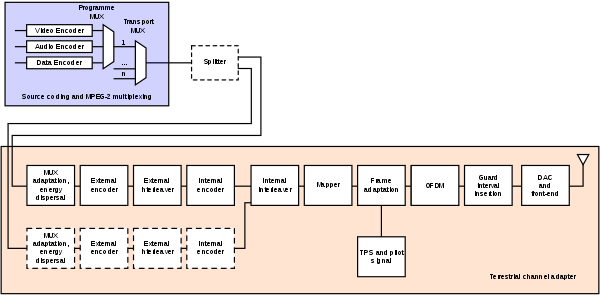
Scheme of a DVB-T manual arrangement
With reference to the figure, a brusque description of the signal processing blocks follows.
- Source coding and MPEG-2 multiplexing (MUX): Compressed video, compressed audio, and data streams are multiplexed into MPEG program streams (MPEG-PSs). 1 or more MPEG-PSs are joined together into an MPEG send stream (MPEG-TS); this is the basic digital stream which is being transmitted and received by Tv set sets or home Set Top Boxes (STB). Immune chip rates for the transported data depend on a number of coding and modulation parameters: it can range from about 5 to virtually 32 Mbit/s (see the bottom figure for a consummate listing).
- Splitter: Ii unlike MPEG-TSs can exist transmitted at the same time, using a technique called Hierarchical Transmission. Information technology may be used to transmit, for case a standard definition SDTV signal and a high definition HDTV signal on the same carrier. Generally, the SDTV bespeak is more robust than the HDTV ane. At the receiver, depending on the quality of the received signal, the STB may be able to decode the HDTV stream or, if point forcefulness lacks, information technology tin switch to the SDTV one (in this way, all receivers that are in proximity of the manual site tin can lock the HDTV point, whereas all the other ones, even the farthest, may still be able to receive and decode an SDTV bespeak).
- MUX accommodation and free energy dispersal: The MPEG-TS is identified as a sequence of data packets, of fixed length (188 bytes). With a technique chosen energy dispersal, the byte sequence is decorrelated.
- External encoder: A first level of error correction is applied to the transmitted data, using a not-binary cake code, a Reed–Solomon RS (204, 188) lawmaking, assuasive the correction of up to a maximum of 8 wrong bytes for each 188-byte packet.
- External interleaver: Convolutional interleaving is used to rearrange the transmitted data sequence, in such a mode that it becomes more rugged to long sequences of errors.
- Internal encoder: A second level of error correction is given by a punctured convolutional lawmaking, which is often denoted in STBs menus as FEC (Forward mistake correction). There are five valid coding rates: ane/2, two/3, 3/4, 5/vi, and 7/8.
- Internal interleaver: Data sequence is rearranged again, aiming to reduce the influence of outburst errors. This time, a block interleaving technique is adopted, with a pseudo-random assignment scheme (this is really done past 2 separate interleaving processes, 1 operating on bits and another 1 operating on groups of bits).
- Mapper: The digital bit sequence is mapped into a base band modulated sequence of complex symbols. At that place are three valid modulation schemes: QPSK, 16-QAM, 64-QAM.
- Frame adaptation: the circuitous symbols are grouped in blocks of constant length (1512, 3024, or 6048 symbols per block). A frame is generated, 68 blocks long, and a superframe is built past iv frames.
- Pilot and TPS signals: In lodge to simplify the reception of the signal beingness transmitted on the terrestrial radio aqueduct, additional signals are inserted in each cake. Pilot signals are used during the synchronization and equalization stage, while TPS signals (Manual Parameters Signalling) send the parameters of the transmitted betoken and to unequivocally identify the transmission prison cell. The receiver must be able to synchronize, equalize, and decode the point to proceeds admission to the information held by the TPS pilots. Thus, the receiver must know this information beforehand, and the TPS data is only used in special cases, such as changes in the parameters, resynchronizations, etc.
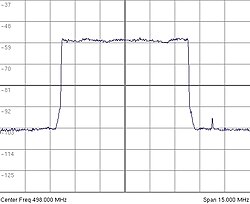
Spectrum of a DVB-T signal in 8k mode (notation the flat-height characteristics)
- OFDM modulation: The sequence of blocks is modulated co-ordinate to the OFDM technique, using 1705 or 6817 carriers (2k or 8k mode, respectively). Increasing the number of carriers does non modify the payload scrap rate, which remains constant.
- Guard interval insertion: to decrease receiver complication, every OFDM block is extended, copying in front of it its own end (circadian prefix). The width of such guard interval can be one/32, ane/xvi, ane/viii, or ane/4 that of the original cake length. Cyclic prefix is required to operate single frequency networks, where at that place may exist an ineliminable interference coming from several sites transmitting the same programme on the same carrier frequency.
- DAC and front-end: The digital signal is transformed into an analogue betoken, with a digital-to-analog converter (DAC), and then modulated to radio frequency (VHF, UHF) past the RF forepart end. The occupied bandwidth is designed to conform each unmarried DVB-T betoken into 5, 6, seven, or 8 MHz wide channels. The base band sample rate provided at the DAC input depends on the channel bandwidth: information technology is samples/s, where is the channel bandwidth expressed in Hz.


| Modulation | Coding rate | Guard interval | |||
|---|---|---|---|---|---|
| ane/4 | 1/8 | 1/16 | i/32 | ||
| QPSK | 1/2 | iv.976 | 5.529 | five.855 | 6.032 |
| 2/3 | 6.635 | 7.373 | 7.806 | viii.043 | |
| 3/4 | seven.465 | 8.294 | viii.782 | 9.048 | |
| 5/6 | 8.294 | 9.216 | 9.758 | 10.053 | |
| 7/eight | 8.709 | 9.676 | 10.246 | 10.556 | |
| 16-QAM | 1/2 | 9.953 | 11.059 | 11.709 | 12.064 |
| two/3 | 13.271 | xiv.745 | 15.612 | 16.086 | |
| 3/4 | 14.929 | xvi.588 | 17.564 | 18.096 | |
| 5/6 | 16.588 | xviii.431 | xix.516 | 20.107 | |
| vii/8 | 17.418 | nineteen.353 | 20.491 | 21.112 | |
| 64-QAM | 1/ii | 14.929 | 16.588 | 17.564 | 18.096 |
| two/3 | 19.906 | 22.118 | 23.419 | 24.128 | |
| 3/4 | 22.394 | 24.882 | 26.346 | 27.144 | |
| 5/6 | 24.882 | 27.647 | 29.273 | 30.160 | |
| 7/eight | 26.126 | 29.029 | xxx.737 | 31.668 | |
Technical clarification of the receiver [edit]
The receiving STB adopts techniques which are dual to those ones used in the transmission.
- Forepart-stop and ADC: the analogue RF signal is converted to base-band and transformed into a digital indicate, using an analogue-to-digital converter (ADC).
- Time and frequency synchronization: the digital base band signal is searched to identify the get-go of frames and blocks. Any problems with the frequency of the components of the signal are corrected, too. The property that the baby-sit interval at the terminate of the symbol is placed also at the beginning is exploited to find the beginning of a new OFDM symbol. On the other manus, continual pilots (whose value and position is adamant in the standard and thus known past the receiver) decide the frequency offset suffered past the signal. This frequency offset might have been caused by Doppler event, inaccuracies in either the transmitter or receiver clock, and then on. More often than not, synchronization is done in two steps, either earlier or after the FFT, in such style to resolve both coarse and fine frequency/timing errors. Pre-FFT steps involve the use of sliding correlation on the received time signal, whereas Post-FFT steps use correlation between the frequency betoken and the airplane pilot carriers sequence.
- Guard interval disposal: the cyclic prefix is removed.
- OFDM demodulation: this is achieved with an FFT.
- Frequency equalization: the airplane pilot signals are used to gauge the Channel Transfer Office (CTF) every three subcarriers. The CTF is derived in the remaining subcarriers via interpolation. The CTF is and then used to equalize the received data in each subcarrier, generally using a Cipher-Forcing method (multiplication by CTF inverse). The CTF is likewise used to weigh the reliability of the demapped data when they are provided to the Viterbi decoder.
- Demapping: since at that place are Gray-encoded QAM constellations, demapping is washed in a "soft" manner using nonlinear laws that demap each chip in the received symbol to a more or less reliable fuzzy value between -1 and +ane.
- Internal deinterleaving
- Internal decoding: uses the Viterbi algorithm, with a traceback length larger than that generally used for the bones 1/2 rate code, due to the presence of punctured ("erased") bits.
- External deinterleaving
- External decoding
- MUX adaptation
- MPEG-2 demultiplexing and source decoding
Countries and territories using DVB-T or DVB-T2 [edit]
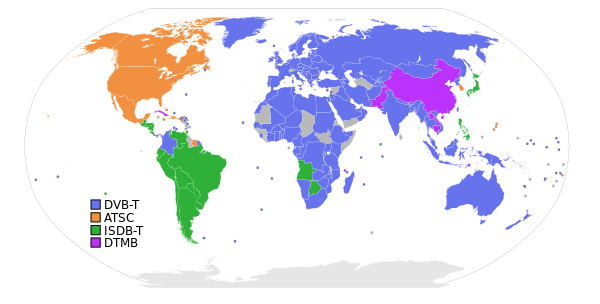
Digital terrestrial television systems worldwide. Countries using DVB-T or DVB-T2 are shown in blue.[ten]
Americas [edit]
Europe [edit]
-
 Albania (uses MPEG-ii for SD and H.264/MPEG-4 AVC for Hd transmissions).
 -
 Andorra
 -
 Austria (transition to DVB-T2)
 -
 Belgium (uses DVB-T MPEG-two and DVB-T2 H.264/MPEG-four AVC)
 -
 Belarus (uses DVB-T H.264/MPEG-iv AVC for SD and Hard disk drive transmission and DVB-T2 for pay SD and Hard disk transmissions)
 -
 Bulgaria (H.264/MPEG-4 AVC, FEC=2/three, guard interval - 1/four, 64 QAM. Official simulcast started in March 2013, total switch has been done on 30 September 2013.)[16] [17]
 -
 Croatia From 2020 the transmission is on DVB-T2 H.265/HEVC with Hard disk 1080p50 - meet Television in Croatia
 -
 Czech republic (MPEG-two, DVB-T2 HEVC H.265 started in 2017)
 -
 Cyprus (H.264/MPEG-iv AVC video)
 -
 Denmark (uses H.264/AVC for SD and Hd transmissions. Come across DVB-T in Kingdom of denmark.)
 -
 Estonia (uses H.264/AVC video)
 -
 Faroe Islands
 -
 Republic of finland
 -
 French republic (uses H.264/AVC for free Hard disk drive, pay SD and pay Hard disk transmissions. See Digital terrestrial television#French republic.)
 -
 Deutschland (partly still DVB-T MPEG-two, SD merely; since 2016 transition to DVB-T2 H.265/HEVC with Hard disk drive 1080p50 - see Tv set in Germany)
 -
 Georgia
 -
 Greece (ERT Digital and Digital Spousal relationship employ MPEG-2 but will shift to H.264/MPEG-4 AVC. Digea, ERT / ERT HD and Digital Union (in Region of Thessalia) apply H.264/MPEG-4 AVC)
 -
 Hungary (branded MinDigTV, uses H.264/MPEG-4 AVC video exclusively.)
 -
 Iceland[18]
 -
 Ireland (uses H.264/MPEG-4 AVC for HD and SD transmissions, meet Saorview)
 -
 Italian republic (uses MPEG-2 for SD, H.264/MPEG-four AVC for Hard disk drive). Transition to DVB-T2 scheduled in 2022.
 -
 Latvia (uses H.264/MPEG-4 AVC)
 -
 Lithuania (uses H.264/MPEG-4 AVC)
 -
 Luxembourg (uses DVB-T MPEG-2 for SD and H.264/MPEG-iv AVC for HD)
 -
 Republic of macedonia (DVB-T in Republic of macedonia)
 -
 Malta
Malta -
 Moldova (uses MPEG-two. H.264/AVC is being tested.)
 -
 Montenegro
 -
 Netherlands (uses DVB-T2, operated past Digitenne)
 -
 Norway (uses H.264/MPEG-iv AVC for SD and Hd transmissions)
 -
 Poland (uses H.264/AVC video for SD and HD transmissions; see DVB-T in Poland)
 -
 Portugal (uses H.264/AVC video;)
 -
 Romania DVB-T was merely used experimentally in ii cities, and is being phased out. The official terrestrial broadcasting standard in Romania is DVB-T2, and implementations started in 2015.
 -
 Russia (uses DVB-T2 H.264/AVC[19])
 -
 Serbia (uses DVB-T2 H.264/AVC[xx])
 -
 Slovakia (uses MPEG-2 for SD and H.264/MPEG-4 AVC for Hd, testing DVB-T2 H.264/AVC)
 -
 Slovenia (uses H.264/MPEG-4 AVC video since 2007. See DVB-T in Slovenia)
 -
 Spain (uses DVB-T MPEG-2 for SD and DVB-T H.264/MPEG-4 for Hard disk drive transmissions.)
 -
 Sweden (uses MPEG-2 and H.264/MPEG-4 AVC) for SD, and DVB-T2 with H.264/AVC for SD and Hard disk drive transmissions. Come across DVB-T in Sweden.)
 -
 Switzerland (1 regional DVB-T station remaining. Terrestrial national TV broadcasting restored using DVB-T2 almost Republic of austria, soon most France)[21]
 -
 Turkey (Non officially rolled out. Concluding known DVB-T2 test broadcasting TRT 4K ended on ane June 2017)
 -
 UK (uses DVB-T MPEG-2 for SD and DVB-T2 H.264/AVC for Hard disk drive transmissions. See DVB-T in United Kingdom.)
 -
 Ukraine (uses DVB-T2 H.264/AVC for all nationwide broadcasts)
Oceania [edit]
Asia [edit]
Africa [edit]
DTT switch-off [edit]
While many countries accept expected a shift to digital terrestrial television, a few have moved in the opposite direction following unsuccessful trials.
- Switzerland : Swiss public broadcaster SRG terminated DTT network on 3 June 2019. A regional station from the Geneva area has kept broadcasting. A DVB-T2 antenna was later activated in the eastward of the country to relay Swiss Tv to Austrian cablevision operators. A like circulate is planned to encompass Grand Geneva.
- Turkey terminated DTT network on 1 June 2017.
Run across also [edit]
- ATSC (Advanced Television Systems Commission, North American Standard)
- Digital Audio Broadcasting (low bit rate video suitable for moving receivers)
- Digital Video Broadcasting (technical standards underpinning DVB-T)
- DTV channel protection ratios
- DVB over IP
- DVB-T2
- Digital terrestrial television
- DMB-T - Digital Multimedia Broadcast-Terrestrial
- Interactive tv
- ISDB - Integrated Services Digital Dissemination
- ISDB-T International
- Multimedia Home Platform (standard to deliver interactive Television set applications over DVB)
- OFDM organization comparison table
- Personal video recorder
- Spectral efficiency comparison table
- Teletext
Notes [edit]
- ^ "ETSI EN 300 744 - Digital Video Dissemination (DVB); Framing structure, channel coding and modulation for digital terrestrial tv set" (PDF). European Telecommunications Standards Institute. October 2015. p. 66.
- ^ "DATAONE LIMITED RESPONSE TO CONSULTATION Paper ON DATACASTING" (PDF). Infocomm Media Development Authorization, Singapore.
- ^ "Television receiver Broadcast FOR SINGAPORE - March 3, 1998" (PDF). 8 October 1999. Archived (PDF) from the original on 8 October 1999. Retrieved v Feb 2020.
- ^ "Advent Boob tube launches the world's offset digital terrestrial service in Singapore" (PDF). viii October 1999. Archived (PDF) from the original on viii Oct 1999. Retrieved five Feb 2020.
- ^ "The Futurity is in Digital Dissemination and that future is with Advent Television". 11 Apr 2001. Archived from the original on 11 April 2001. Retrieved 5 February 2020.
- ^ "Printing Release - April 27, 1998" (PDF). 4 June 2000. Archived (PDF) from the original on iv June 2000. Retrieved 5 February 2020.
- ^ "S'pore testing digital TV format". The Business Times. 5 March 1998. p. iv.
- ^ "SBA plans to launch digital Boob tube later on trying out systems". The Straits Times. ix March 1998. p. 30.
- ^ "DGTVi - Per la Televisione Digitale Terrestre" (in Italian). Archived from the original on 2008-04-19. Retrieved 2008-07-xxx .
{{cite web}}: CS1 maint: unfit URL (link) - ^ DVB.org Archived twenty March 2011 at the Wayback Motorcar, Official information taken from the DVB website
- ^ "Virtually - DVB". Archived from the original on 1 September 2013. Retrieved 26 June 2016.
- ^ "Republic of colombia adopta el estándar europeo para la tv digital terrestre". El Espectador (in Castilian). 28 August 2008. Archived from the original on thirteen Apr 2019. Retrieved 28 August 2008.
- ^ "TV Digital no ha llegado a toda Republic of colombia y la CNTV ya piensa en modificar la norma". Evaluamos (in Spanish). 21 July 2011.
- ^ "Panama adopts DVB-T". DVB.org. 19 May 2009. Archived from the original on 3 September 2013. Retrieved 26 June 2016.
- ^ "KTV Ltd". Retrieved 26 June 2016.
- ^ "Program for the introduction of terrestrial digital tv broadcasting (DVB-T) in the Bulgaria" (in Bulgarian). Ministry building of Transport, Information Applied science and Communications of Bulgaria. Retrieved 17 Dec 2012.
- ^ "Digital Television". NURTS (TV tower operator). Archived from the original on 1 December 2012. Retrieved 17 December 2012.
- ^ "Digital Ísland" (in Icelandic). fjarskiptahandbokin.is. Archived from the original on 31 August 2009. Retrieved 27 Oct 2009.
- ^ "Russian federation adopts DVB-T2". Avant-garde-Television.com. 29 September 2011.
- ^ "ETV: trial DVB-T2 network" (in Serbian). Archived from the original on 16 April 2012. Retrieved 22 March 2012.
- ^ "Switzerland to switch off DTT on June 3, 2019". 6 December 2018.
- ^ "100,000 likes – Oqaab reaches over ane Mio Telly Households". Oqaab.af. 31 March 2015. Archived from the original on 23 March 2016. Retrieved 26 June 2016.
- ^ a b c d due east f thou h Hawkes, Rebecca (19 May 2014). "Samart optics Middle E market for digital TV-enabled smartphone". Rapid Television receiver News . Retrieved 26 June 2016.
- ^ "Digital TV services to be introduced in People's republic of bangladesh by 2014". Asia-Pacific Broadcasting Spousal relationship. v June 2012.
- ^ "PERSYARATAN TEKNIS ALAT DAN PERANGKAT PENERIMA TELEVISI SIARAN DIGITAL BERBASIS STANDAR DIGITAL VIDEO Dissemination TERRESTRIAL – Second GENERATION" (PDF). KomInfo.go.id. Ministry of Communication and Information Applied science (Republic of indonesia). Retrieved ane April 2017.
- ^ "Standar Penyiaran Televisi Digital" (PDF). KomInfo.get.id. Ministry of Communication and Information Technology (Republic of indonesia). Archived from the original (PDF) on 27 June 2017. Retrieved 19 February 2012.
- ^ Hawkes, Rebecca (26 February 2014). "State of kuwait TV opts for Harris DVB-T2 applied science". Rapid Telly News . Retrieved 11 April 2014.
- ^ "Kyrgyztelecom launches DVB-T2 & DVB-S2". DVB.org. 7 Nov 2014. Archived from the original on 19 April 2016. Retrieved seven April 2016.
- ^ "北朝鮮で4局が地上デジタル放送を実施中、ASUS ZenFone Go TVで確認". blogofmobile.com (in Japanese). 8 September 2019. Retrieved 24 June 2020.
- ^ Williams, Martyn (17 March 2013). "Report: DPRK testing digital TV". North korea Tech - 노스코리아테크. Archived from the original on 23 September 2019. Retrieved 25 September 2019.
- ^ "Qatar Goes DVB-T2". DVB.org. 11 Dec 2013. Archived from the original on 26 September 2019. Retrieved 12 April 2014.
- ^ "Tajikistan Confirms DVB-T2 Adoption". DVB.org. 4 Feb 2014. Archived from the original on 29 Dec 2016. Retrieved 7 April 2016.
- ^ Mochiko, Thabiso (26 Nov 2010). "BusinessDay - State U-turn on Nyanda's digital-Tv set point plan". BusinessDay.co.za. BDFM Publishers. Archived from the original on thirty November 2010. Retrieved 26 November 2010.
- ^ Etherington-Smith, James (3 January 2011). "DVB-T2 chosen equally digital TV standard". MyBroadband.co.za . Retrieved iii January 2011.
References [edit]
- ETSI Standard: EN 300 744 V1.5.ane, Digital Video Broadcasting (DVB); Framing structure, channel coding and modulation for digital terrestrial tv set, available at ETSI Publications Download Area (This volition open up ETSI certificate search engine, to find the latest version of the document enter a search string; gratis registration is required to download PDF.)
External links [edit]

Wikimedia Commons has media related to DVB-T.
- Website of the DVB Project
- Official factsheet of DVB-T
- DigiTAG website
Source: https://en.wikipedia.org/wiki/DVB-T
Posted by: wilketherechat.blogspot.com
0 Response to "Dvb T Dvb S Receiver Kombi"
Post a Comment