

Haese Mathematics Ib Hl Worked Solutions Pdf


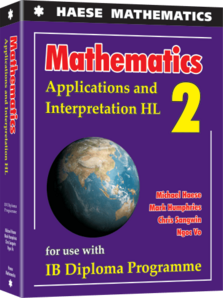
Series: IB Diploma Programme
Mathematics: Applications and Interpretation HL
+
Physical & Digital Copy
ISBN: 978-1-925489-60-6
$59.40 Australia
(AUD including GST)
$54.00 International
(AUD excl. GST)
Digital Copy duration: 24 months
$41.58 Australia
(AUD including GST)
$37.80 International
(AUD excl. GST)
Digital Copy duration: 24 months
About the Book
For an online preview, please email IB@haesemathematics.com.
This book has been written for the IB Diploma Programme course Mathematics: Applications and Interpretation HL, for first assessment in May 2021.
This book is designed to complete the course in conjunction with the Mathematics: Core Topics HL textbook. It is expected that students will start using this book approximately 6-7 months into the two-year course, upon the completion of the Core Topics HL textbook.
This product has been developed independently from and is not endorsed by the International Baccalaureate Organization. International Baccalaureate, Baccalaureát International, Bachillerato Internacional and IB are registered trademarks owned by the International Baccalaureate Organization.
Year Published: 2019
Page Count: 968
ISBN: 978-1-925489-60-6 (9781925489606)
Online ISBN: 978-1-925489-72-9 (9781925489729)
Table of Contents
Mathematics: Applications and Interpretation HL
| 1 | EXPONENTIALS | 13 | |
| A | Rational exponents | 14 | |
| B | Algebraic expansion and factorisation | 16 | |
| C | Exponential functions | 19 | |
| D | Graphing exponential functions from a table of values | 20 | |
| E | Graphs of exponential functions | 21 | |
| F | Exponential equations | 25 | |
| G | Growth and decay | 27 | |
| H | The natural exponential | 34 | |
| I | The logistic model | 39 | |
| Review set 1A | 40 | ||
| Review set 1B | 42 | ||
| 2 | LOGARITHMS | 45 | |
| A | Logarithms in base $10$ | 46 | |
| B | Laws of logarithms | 49 | |
| C | Natural logarithms | 52 | |
| D | Logarithmic functions | 56 | |
| E | Logarithmic scales | 59 | |
| Review set 2A | 64 | ||
| Review set 2B | 65 | ||
| 3 | APPROXIMATIONS AND ERROR | 67 | |
| A | Errors in measurement | 68 | |
| B | Absolute and percentage error | 71 | |
| Review set 3A | 75 | ||
| Review set 3B | 75 | ||
| 4 | LOANS AND ANNUITIES | 77 | |
| A | Loans | 78 | |
| B | Annuities | 84 | |
| Review set 4A | 88 | ||
| Review set 4B | 89 | ||
| 5 | MODELLING | 91 | |
| A | The modelling cycle | 92 | |
| B | Linear models | 98 | |
| C | Piecewise models | 101 | |
| D | Systems of equations | 108 | |
| Review set 5A | 111 | ||
| Review set 5B | 114 | ||
| 6 | DIRECT AND INVERSE VARIATION | 117 | |
| A | Direct variation | 118 | |
| B | Powers in direct variation | 122 | |
| C | Inverse variation | 123 | |
| D | Powers in inverse variation | 126 | |
| E | Determining the variation model | 127 | |
| F | Using technology to find variation models | 129 | |
| Review set 6A | 131 | ||
| Review set 6B | 133 | ||
| 7 | BIVARIATE STATISTICS | 135 | |
| A | Association between numerical variables | 136 | |
| B | Pearson's product-moment correlation coefficient | 141 | |
| C | The coefficient of determination | 146 | |
| D | Line of best fit by eye | 148 | |
| E | The least squares regression line | 152 | |
| F | Statistical reliability and validity | 160 | |
| G | Spearman's rank correlation coefficient | 164 | |
| Review set 7A | 169 | ||
| Review set 7B | 172 | ||
| 8 | NON-LINEAR MODELLING | 175 | |
| A | Logarithmic models | 176 | |
| B | Exponential models | 178 | |
| C | Power models | 181 | |
| D | Problem solving | 184 | |
| E | Non-linear regression | 186 | |
| Review set 8A | 189 | ||
| Review set 8B | 191 | ||
| 9 | VECTORS | 193 | |
| A | Vectors and scalars | 194 | |
| B | Geometric operations with vectors | 197 | |
| C | Vectors in the plane | 202 | |
| D | The magnitude of a vector | 204 | |
| E | Operations with plane vectors | 205 | |
| F | Vectors in space | 209 | |
| G | Operations with vectors in space | 211 | |
| H | The vector between two points | 212 | |
| I | Parallelism | 217 | |
| J | The scalar product of two vectors | 220 | |
| K | The angle between two vectors | 222 | |
| L | The vector product of two vectors | 227 | |
| M | Vector components | 234 | |
| Review set 9A | 237 | ||
| Review set 9B | 239 | ||
| 10 | VECTOR APPLICATIONS | 241 | |
| A | Lines in $2$ and $3$ dimensions | 242 | |
| B | The angle between two lines | 246 | |
| C | Constant velocity problems | 248 | |
| D | The shortest distance from a point to a line | 251 | |
| E | The shortest distance between two objects | 254 | |
| F | Intersecting lines | 256 | |
| Review set 10A | 261 | ||
| Review set 10B | 263 | ||
| 11 | COMPLEX NUMBERS | 265 | |
| A | Real quadratics with $\Delta < 0$ | 266 | |
| B | Complex numbers | 268 | |
| C | Operations with complex numbers | 269 | |
| D | Equality of complex numbers | 272 | |
| E | The complex plane | 273 | |
| F | Modulus and argument | 276 | |
| G | Geometry in the complex plane | 279 | |
| H | Polar form | 282 | |
| I | Exponential form | 290 | |
| J | Frequency and phase | 292 | |
| Review set 11A | 293 | ||
| Review set 11B | 295 | ||
| 12 | MATRICES | 297 | |
| A | Matrix structure | 298 | |
| B | Matrix equality | 300 | |
| C | Addition and subtraction | 301 | |
| D | Scalar multiplication | 303 | |
| E | Matrix algebra | 305 | |
| F | Matrix multiplication | 307 | |
| G | The inverse of a matrix | 314 | |
| H | Simultaneous linear equations | 318 | |
| Review set 12A | 323 | ||
| Review set 12B | 325 | ||
| 13 | EIGENVALUES AND EIGENVECTORS | 327 | |
| A | Eigenvalues and eigenvectors | 328 | |
| B | Matrix diagonalisation | 333 | |
| C | Matrix powers | 336 | |
| D | Markov chains | 338 | |
| Review set 13A | 349 | ||
| Review set 13B | 351 | ||
| 14 | AFFINE TRANSFORMATIONS | 353 | |
| A | Translations | 355 | |
| B | Rotations about the origin | 356 | |
| C | Reflections | 359 | |
| D | Stretches | 361 | |
| E | Enlargements | 362 | |
| F | Composite transformations | 363 | |
| G | Area | 367 | |
| Review set 14A | 372 | ||
| Review set 14B | 373 | ||
| 15 | GRAPH THEORY | 375 | |
| A | Graphs | 376 | |
| B | Properties of graphs | 380 | |
| C | Routes on graphs | 383 | |
| D | Adjacency matrices | 385 | |
| E | Transition matrices for graphs | 392 | |
| F | Trees | 394 | |
| G | Minimum spanning trees | 395 | |
| H | Eulerian graphs | 401 | |
| I | The Chinese Postman Problem | 404 | |
| J | Hamiltonian graphs | 406 | |
| K | The Travelling Salesman Problem | 409 | |
| Review set 15A | 416 | ||
| Review set 15B | 419 | ||
| 16 | VORONOI DIAGRAMS | 423 | |
| A | Voronoi diagrams | 424 | |
| B | Constructing Voronoi diagrams | 428 | |
| C | Adding a site to a Voronoi diagram | 433 | |
| D | Nearest neighbour interpolation | 437 | |
| E | The Largest Empty Circle problem | 439 | |
| Review set 16A | 443 | ||
| Review set 16B | 445 | ||
| 17 | INTRODUCTION TO DIFFERENTIAL CALCULUS | 447 | |
| A | Rates of change | 449 | |
| B | Instantaneous rates of change | 452 | |
| C | Limits | 455 | |
| D | The gradient of a tangent | 460 | |
| E | The derivative function | 462 | |
| F | Differentiation from first principles | 464 | |
| Review set 17A | 466 | ||
| Review set 17B | 467 | ||
| 18 | RULES OF DIFFERENTIATION | 469 | |
| A | Simple rules of differentiation | 470 | |
| B | The chain rule | 474 | |
| C | The product rule | 477 | |
| D | The quotient rule | 479 | |
| E | Derivatives of exponential functions | 482 | |
| F | Derivatives of logarithmic functions | 485 | |
| G | Derivatives of trigonometric functions | 487 | |
| H | Second derivatives | 490 | |
| Review set 18A | 492 | ||
| Review set 18B | 493 | ||
| 19 | PROPERTIES OF CURVES | 495 | |
| A | Tangents | 496 | |
| B | Normals | 502 | |
| C | Increasing and decreasing | 503 | |
| D | Stationary points | 508 | |
| E | Shape | 513 | |
| F | Inflection points | 515 | |
| Review set 19A | 519 | ||
| Review set 19B | 521 | ||
| 20 | APPLICATIONS OF DIFFERENTIATION | 523 | |
| A | Rates of change | 524 | |
| B | Optimisation | 529 | |
| C | Modelling with calculus | 537 | |
| D | Related rates | 540 | |
| Review set 20A | 543 | ||
| Review set 20B | 545 | ||
| 21 | INTRODUCTION TO INTEGRATION | 547 | |
| A | Approximating the area under a curve | 548 | |
| B | The Riemann integral | 552 | |
| C | Antidifferentiation | 556 | |
| D | The Fundamental Theorem of Calculus | 558 | |
| Review set 21A | 563 | ||
| Review set 21B | 564 | ||
| 22 | TECHNIQUES FOR INTEGRATION | 565 | |
| A | Discovering integrals | 566 | |
| B | Rules for integration | 568 | |
| C | Particular values | 572 | |
| D | Integrating $f(ax+b)$ | 574 | |
| E | Integration by substitution | 577 | |
| Review set 22A | 580 | ||
| Review set 22B | 581 | ||
| 23 | DEFINITE INTEGRALS | 583 | |
| A | Definite integrals | 584 | |
| B | Definite integrals involving substitution | 587 | |
| C | The area under a curve | 588 | |
| D | The area above a curve | 592 | |
| E | The area between a curve and the $y$-axis | 596 | |
| F | Solids of revolution | 598 | |
| G | Problem solving by integration | 602 | |
| Review set 23A | 604 | ||
| Review set 23B | 606 | ||
| 24 | KINEMATICS | 609 | |
| A | Displacement | 611 | |
| B | Velocity | 613 | |
| C | Acceleration | 619 | |
| D | Speed | 623 | |
| E | Velocity and acceleration in terms of displacement | 626 | |
| F | Motion with variable velocity | 628 | |
| G | Projectile motion | 634 | |
| Review set 24A | 638 | ||
| Review set 24B | 640 | ||
| 25 | DIFFERENTIAL EQUATIONS | 643 | |
| A | Differential equations | 644 | |
| B | Solutions of differential equations | 646 | |
| C | Differential equations of the form $\frac{dy}{dx}=f(x)$ | 649 | |
| D | Separable differential equations | 652 | |
| E | Slope fields | 658 | |
| F | Euler's method for numerical integration | 661 | |
| Review set 25A | 666 | ||
| Review set 25B | 667 | ||
| 26 | COUPLED DIFFERENTIAL EQUATIONS | 669 | |
| A | Phase portraits | 671 | |
| B | Coupled linear differential equations | 678 | |
| C | Second order differential equations | 686 | |
| D | Euler's method for coupled equations | 688 | |
| Review set 26A | 693 | ||
| Review set 26B | 694 | ||
| 27 | DISCRETE RANDOM VARIABLES | 697 | |
| A | Random variables | 698 | |
| B | Discrete probability distributions | 700 | |
| C | Expectation | 703 | |
| D | Variance and standard deviation | 709 | |
| E | Properties of $aX + b$ | 711 | |
| F | The binomial distribution | 714 | |
| G | Using technology to find binomial probabilities | 718 | |
| H | The mean and standard deviation of a binomial distribution | 721 | |
| I | The Poisson distribution | 722 | |
| Review set 27A | 726 | ||
| Review set 27B | 728 | ||
| 28 | THE NORMAL DISTRIBUTION | 731 | |
| A | Introduction to the normal distribution | 733 | |
| B | Calculating probabilities | 736 | |
| C | The standard normal distribution | 743 | |
| D | Quantiles | 748 | |
| Review set 28A | 751 | ||
| Review set 28B | 753 | ||
| 29 | ESTIMATION AND CONFIDENCE INTERVALS | 755 | |
| A | Linear combinations of random variables | 756 | |
| B | The sum of two independent Poisson random variables | 759 | |
| C | Linear combinations of normal random variables | 760 | |
| D | The Central Limit Theorem | 762 | |
| E | Confidence intervals for a population mean with known variance | 768 | |
| F | Confidence intervals for a population mean with unknown variance | 776 | |
| Review set 29A | 779 | ||
| Review set 29B | 781 | ||
| 30 | HYPOTHESIS TESTING | 783 | |
| A | Statistical hypotheses | 785 | |
| B | The $Z$-test | 787 | |
| C | Critical values and critical regions | 794 | |
| D | Student's $t$-test | 797 | |
| E | Paired $t$-tests | 800 | |
| F | The two-sample $t$-test for comparing population means | 803 | |
| G | Hypothesis tests for the mean of a Poisson population | 805 | |
| H | Hypothesis tests for a population proportion | 809 | |
| I | Hypothesis tests for a population correlation coefficient | 813 | |
| J | Error probabilities and statistical power | 817 | |
| Review set 30A | 824 | ||
| Review set 30B | 826 | ||
| 31 | $\chi^2$ HYPOTHESIS TESTS | 829 | |
| A | The $\chi^2$ goodness of fit test | 830 | |
| B | Estimating distribution parameters in a goodness of fit test | 838 | |
| C | Critical regions and critical values | 842 | |
| D | The $\chi^2$ test for independence | 844 | |
| Review set 31A | 851 | ||
| Review set 31B | 853 | ||
| ANSWERS | 855 | ||
| INDEX | 967 | ||
Authors
- Michael Haese
- Mark Humphries
- Chris Sangwin
- Ngoc Vo
Author

Michael Haese
Michael completed a Bachelor of Science at the University of Adelaide, majoring in Infection and Immunity, and Applied Mathematics. He studied laminar heat flow as part of his Honours in Applied Mathematics, and finished a PhD in high speed fluid flows in 2001. He has been the principal editor for Haese Mathematics since 2008.
What motivates you to write mathematics books?
My passion is for education as a whole, rather than just mathematics. In Australia I think it is too easy to take education for granted, because it is seen as a right but with too little appreciation for the responsibility that goes with it. But the more I travel to places where access to education is limited, the more I see children who treat it as a privilege, and the greater the difference it makes in their lives. But as far as mathematics goes, I grew up with mathematics textbooks in pieces on the kitchen table, and so I guess it continues a tradition.
What do you aim to achieve in writing?
I think a few things:
- I want to write to the student directly, so they can learn as much as possible from the text directly. Their book is there even when their teacher isn't.
- I therefore want to write using language which is easy to understand. Sure, mathematics has its big words, and these are important and we always use them. But the words around them should be as simple as possible, so the meaning of the terms can be properly explained to ESL (English as a Second Language) students.
- I want to make the mathematics more alive and real, not by putting it in contrived "real-world" contexts which are actually over-simplified and fake, but rather through its history and its relationship with other subjects.
What interests you outside mathematics?
Lots of things! Horses, show jumping and course design, alpacas, badminton, running, art, history, faith, reading, hiking, photography ....
Author

Mark Humphries
Mark has a Bachelor of Science (Honours), majoring in Pure Mathematics, and a Bachelor of Economics, both of which were completed at the University of Adelaide. He studied public key cryptography for his Honours in Pure Mathematics. He started with the company in 2006, and is currently the writing manager for Haese Mathematics.
What got you interested in mathematics? How did that lead to working at Haese Mathematics?
I have always enjoyed the structure and style of mathematics. It has a precision that I enjoy. I spend an inordinate amount of my leisure time reading about mathematics, in fact! To be fair, I tend to do more reading about the history of mathematics and how various mathematical and logic puzzles work, so it is somewhat different from what I do at work.
How did I end up at Haese Mathematics?
I was undertaking a PhD, and I realised that what I really wanted to do was put my knowledge to use. I wanted to pass on to others all this interesting stuff about mathematics. I emailed Haese Mathematics (Haese and Harris Publications as they were known back then), stating that I was interested in working for them. As it happened, their success with the first series of International Baccalaureate books meant that they were looking to hire more people at the time. I consider myself quite lucky!
What are some interesting things that you get to do at work?
On an everyday basis, it's a challenge (but a fun one!) to devise interesting questions for the books. I want students to have questions that pique their curiosity and get them thinking about mathematics in a different way. I prefer to write questions that require students to demonstrate that they understand a concept, rather than relying on rote memorisation.
When a new or revised syllabus is released for a curriculum that we write for, a lot of work goes into devising a structure for the book that addresses the syllabus. The process of identifying what concepts need to be taught, organising those concepts into an order that makes sense from a teaching standpoint, and finally sourcing and writing the material that addresses those concepts is very involved – but so rewarding when you hold the finished product in your hands, straight from the printer.
What interests you outside mathematics?
Apart from the aforementioned recreational mathematics activities, I play a little guitar, and I enjoy playing badminton and basketball on a social level.
Author

Chris Sangwin
Chris completed a BA in Mathematics at the University of Oxford, and an MSc and PhD in Mathematics at the University of Bath. He spent thirteen years in the Mathematics Department at the University of Birmingham, and from 2000-2011 was seconded half time to the UK Higher Education Academy "Maths Stats and OR Network" to promote learning and teaching of university mathematics. He was awarded a National Teaching Fellowship in 2006. Chris Sangwin joined the University of Edinburgh in 2015 as Professor of Technology Enhanced Science Education.
What are your learning and teaching interests in mathematics?
I teach mathematics at university but am particularly interested in core pure mathematics which starts in school and continues to be taught at university. Solving mathematical problems is at the heart of mathematics, and I enjoy teaching problem solving at university.
What interests you outside mathematics?
I really enjoy hill walking and mountaineering, particularly spending time with friends in the hills.
Why do you choose to collaborate with a small publisher on the other side of the world?
There is a unique team spirit in Haese which other publishers don't have. This makes authorship much more collaborative than my previous experiences, which is really enjoyable and I'm sure leads to much better quality books for students which are, after all, the whole point.
Author

Ngoc Vo
Ngoc Vo completed a Bachelor of Mathematical Sciences at the University of Adelaide, majoring in Statistics and Applied Mathematics. Her Mathematical interests include regression analysis, Bayesian statistics, and statistical computing. Ngoc has been working at Haese Mathematics as a proof reader and writer since 2016.
What drew you to the field of mathematics?
Originally, I planned to study engineering at university, but after a few weeks I quickly realised that it wasn't for me. So I switched to a mathematics degree at the first available opportunity. I didn't really have a plan to major in statistics, but as I continued my studies I found myself growing more fond of the discipline. The mathematical rigor in proving distributional results and how they link to real-world data -- it all just seemed to click.
What are some interesting things that you get to do at work?
As the resident statistician here at Haese Mathematics, I get the pleasure of writing new statistics chapters and related material. Statistics has always been a challenging subject to both teach and learn, however it doesn't always have to be that way. To bridge that gap, I like to try and include as many historical notes, activities, and investigations as I can to make it as engaging as possible. The reasons why we do things, and the people behind them are often important things we forget to talk about. Statistics, and of course mathematics, doesn't just exist within the pages of your textbook or even the syllabus. There's so much breadth and depth to these disciplines, most of the time we just barely scratch the surface.
What interests you outside mathematics?
In my free time I like studying good typography and brushing up on my TeX skills to become the next TeXpert. On the less technical side of things, I also enjoy scrapbooking, painting, and making the occasional card.
Features
-
Snowflake (24 months)
A complete electronic copy of the textbook, with interactive, animated, and/or printable extras.
-
Self Tutor
Animated worked examples with step-by-step, voiced explanations.
-
Theory of Knowledge
Activities to guide Theory of Knowledge projects.
-
Graphics Calculator Instructions
For Casio fx-CG50, TI-84 Plus CE, TI-nspire, and HP Prime

This book offers SELF TUTOR for every worked example. On the electronic copy of the textbook, access SELF TUTOR by clicking anywhere on a worked example to hear a step-by-step explanation by a teacher. This is ideal for catch-up and revision, or for motivated students who want to do some independent study outside school hours.

Graphics calculator instructions for Casio fx-CG50, TI-84 Plus CE, TI-nspire, and HP Prime are included with this textbook. The textbook will either have comprehensive instructions at the start of the book, specific instructions available from icons located throughout, or both. The extensive use of graphics calculators and computer packages throughout the book enables students to realise the importance, application, and appropriate use of technology.

Theory of Knowledge is a core requirement in the International Baccalaureate Diploma Programme.
Students are encouraged to think critically and challenge the assumptions of knowledge. Students should be able to analyse different ways of knowing and kinds of knowledge, while considering different cultural and emotional perceptions, fostering an international understanding.

This book is available on electronic devices through our Snowflake learning platform. This book includes 24 months of Snowflake access, featuring a complete electronic copy of the textbook.
Where relevant, Snowflake features include interactive geometry, graphing, and statistics software, demonstrations, games, spreadsheets, and a range of printable worksheets, tables, and diagrams. Teachers are provided with a quick and easy way to demonstrate concepts, and students can discover for themselves and re-visit when necessary.
Support material
-
Errata
Last updated - 18 Aug 2021
Related Products
Haese Mathematics
Proudly Supports



- Haese Publications
- International Baccalaureate (IB)
- Australian Curriculum
- Cambridge Assessment International Education
- UK Curricula
- Mathematics Dictionary
- The Mathematics Book [published by Zenolith]
- Previous Editions and Clearances
- Digital Books
- Infinity Question Generators
- Snowflake Online Learning
- Support
- Errata
- FAQs
- News & Events
- About Us
- Contact
- Snowflake Login
Haese Mathematics
Mailing List
SUBSCRIBE: Register your interest for information related to Haese Mathematics products
Haese Mathematics Ib Hl Worked Solutions Pdf
Source: https://www.haesemathematics.com/books/mathematics-applications-and-interpretation-hl
Posted by: wilketherechat.blogspot.com
0 Response to "Haese Mathematics Ib Hl Worked Solutions Pdf"
Post a Comment