

How To Find The Template In A Wordpress
Instructions
If you lot're working on a new custom theme, modifying some theme templates, or trying to brand a re-create of a template file for a kid theme you lot'll demand to know how to find which WordPress template file you need to edit or copy, and sometimes this isn't very easy.
If you're annihilation similar me y'all might end up calculation featherbrained little $.25 of HTML like a <p> tag containing the template file name somewhere in the template code to see if information technology shows up on the page.
I still do this sometimes just a lot less since I found this lovely little snippet of code.
Safety first
To find which WordPress template file is currently in use we are going to need to add a little code to your WordPress theme and you need to practice this safely.
There's a general proficient practice rule in WordPress development that you shouldn't actually work on a live site (improve to deploy onto a staging area and then migrate to live on the next push) or that working directly on a theme template file in a alive site is a bad thought, and I would by and large agree with this. However…
This is a temporary measure you can switch on and off when needed to help y'all place something every bit a developer that a user volition never run across. That said and washed I don't want to see you bring down your site either then please carry in mind the post-obit:
- If yous add together this code to your live site and you go information technology wrong or put information technology in the wrong place you might bring your alive or staging site downward.
- If you manage to do this desperately enough you might get the dreaded "white screen of death" and might non even be able to access your WordPress admin so y'all should probably have access to your theme files on the server via S/FTP or your host control panel.
- If you add together this code to your themes functions.php file and the theme gets an update yous'll lose this lawmaking and so yous might want to work with a child theme instead.
Let's find which WordPress template file is in apply
To find which WordPress template file is currently in apply, y'all'll demand to find and get access to your theme's functions.php file outset.
You can do this direct in your WordPress admin (assuming you take full admin user rights). However some developers might cake this from being possible – even to admins, and this could be dangerous to your site – See ABOVE. But if you want to use this method become to Advent > Theme Editor. Then pick the functions.php file from the list of files on the right of the panel.
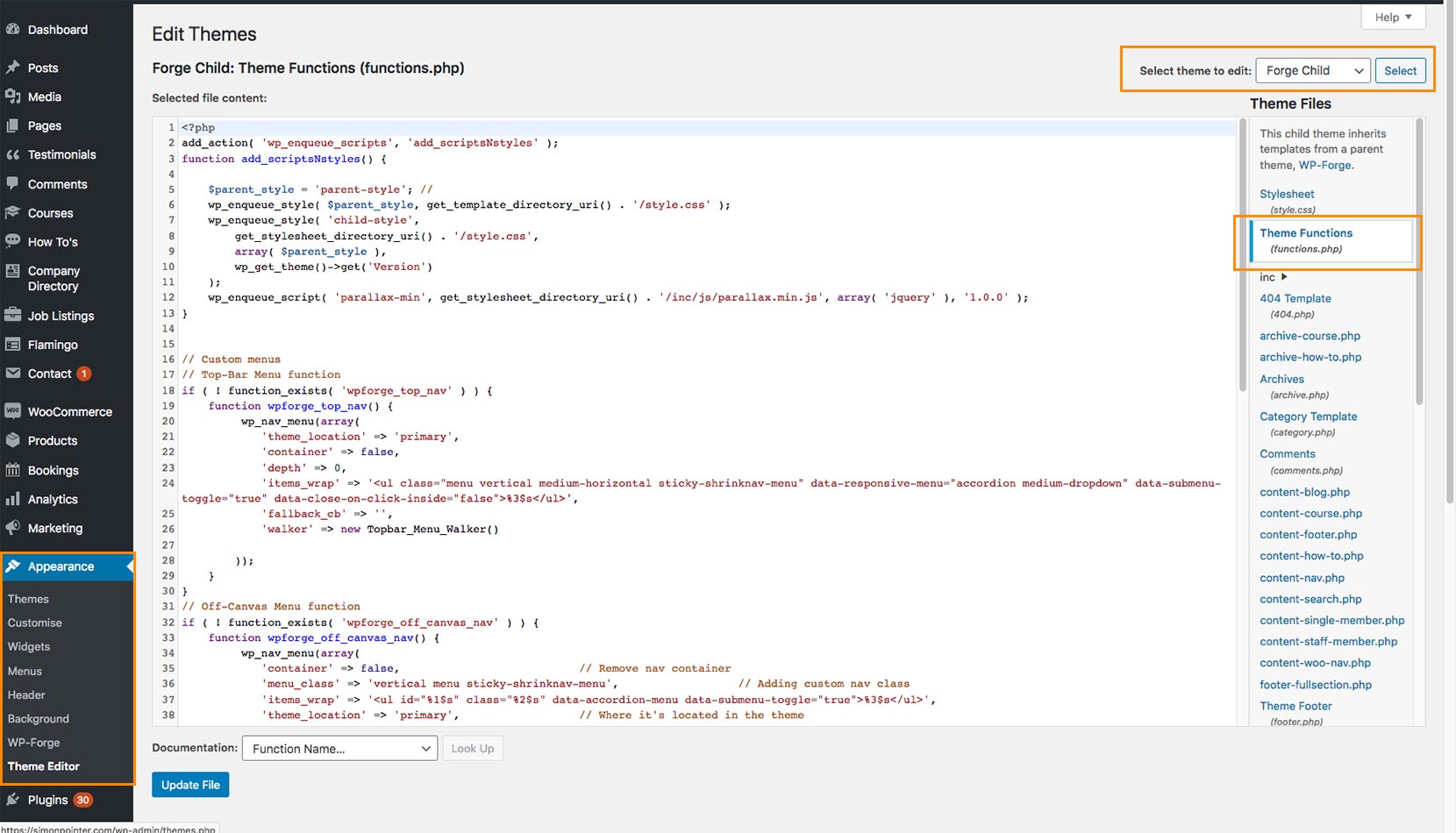
Screenshot showing you how to edit the WordPress theme functions.php file via admin panel
Amend still would be to utilize your favorite S/FTP client or file manager in your control console to access your files on the server and download the functions.php file and open it with your favorite code editor.
NB: It would be a skillful idea to make a copy of the existing functions.php file earlier you add your code just in case you mess it upwardly. (Just select all the code and re-create and past it into a plain text certificate – save the file somewhere sensible).
Add the post-obit code
Add together the post-obit little fleck of lawmaking right at the bottom of your themes functions.php file afterward everything else.
          <?php
            // prove the template file existence used in the footer area - user must have admin bar showing and exist logged in
            add_action( 'admin_bar_menu', 'show_template' );
            function show_template() {
            global $template;
            print_r( $template );
            }
            ?>
If yous prefer you can add this inside the existing PHP tags rather than creating new ones.
Go to the very bottom of the file and copy the following code instance (note no opening and closing PHP tags) and paste it in but Earlier the closing PHP tag in your functions.php file which looks similar this ?> Make sure you paste this after the last closing curly caryatid } that closes the current last function, or you'll be trying to paste a function inside another 1!
            // testify the template file being used - user must have admin bar showing and be logged in
            add_action( 'admin_bar_menu', 'show_template' );
            function show_template() {
            global $template;
            print_r( $template );
            }
What does it exercise?
The outset line (add_action) is a WordPress claw that tells WordPress when to run the function – in this case, the values (parameters) tell it to execute this function's proper noun only if the user is logged in and the admin bar is visible.
The lawmaking then declares a office called show_template which accesses the currently used template proper noun and location and shows it (print_r) on the screen.
Depending on the layout of your site and theme this will typically bear witness up in the height left or lesser left corner of the screen.
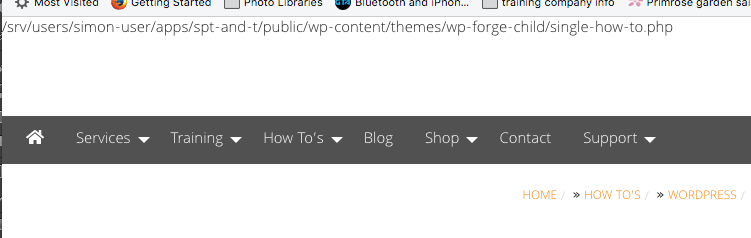
Screenshot showing the template name and file path being displayed
If you lot want to leave the code in place and switch it on and off when yous need it (that's what I do) so simply comment out the part with standard PHP multiline comment tags to turn it off and and then remove them to turn information technology on again.
          <?php
            // prove the template file being used - user must accept admin bar showing and be logged in
            /* add_action( 'admin_bar_menu', 'show_template' );
            function show_template() {
            global $template;
            print_r( $template );
            } */
            ?>
More about WordPress templates
The limit with this is that it will only show the proper noun of the primary template being used and not the names of whatever other templates or template parts that this principal template might call to brandish the content.
Information technology is however a great beginning point to keep forward from.
If y'all're not so familiar with WordPress templates, don't worry, you lot'll go used to it. For at present, all you need to know is that often a primary template file volition load snippets of code from other templates using the get_template_part function. Think of it as code existence loaded inside other code, like a cupboard that contains draws that intern contains boxes.
I know information technology seems difficult and a bit of a hurting but it makes things efficient as one template file could be loaded lots of times by unlike principal templates so information technology tin be re-used over and over once more without it being coded into every primary template.
For example, the folio you're looking at is using a template file called unmarried-how-to.php, which you can run into in the screen shot to a higher place, but if y'all look at the lawmaking of this file it looks like this:
          <?php
            get_header(); ?>            <div class="minor-12 large-12 cell">
              <?php if ( function_exists('yoast_breadcrumb') ) { yoast_breadcrumb('<nav aria-label="You are here:" role="navigation"><ul class="breadcrumbs">','</ul></nav>'); } ?>
              </div>            <div id="content" class="small-12 large-eight prison cell" role="main">            <?php
              global $wp;
              $current_url = home_url( add_query_arg( array(), $wp->request ) );
              ?>            <?php
              $another_url = "/" . $_SERVER['HTTP_HOST'] . $_SERVER['REQUEST_URI'];
              ?>            <?php
              $obj_id = get_queried_object_id();
              $third_url = get_permalink( $obj_id );
              ?>            <?php
              // Get the queried object and sanitize it
              $current_page = sanitize_post( $GLOBALS['wp_the_query']->get_queried_object() );
              // Get the page slug
              $slug = $current_page->post_name;
              ?>            <?php while ( have_posts() ) : the_post(); ?>
              <?php get_template_part( 'content-how-to', get_post_format() ); ?>                                <?php comments_template( '', true ); ?>
              <?php endwhile; // end of the loop. ?>
              </div><!-- #content -->
              <?php get_sidebar(); ?>
              <?php get_footer(); ?>
Obviosuly there is non much HTML or ther code in hither that controls the content displayed on the page, so it's still a piddling dissapointing. However if you lot look through your template file it will probable refer to other templates that practice command this.
Look through the template code of the chief file for anything that says "get_template_part" like this:
<?php get_template_part( 'content-how-to', get_post_format() ); ?> Inside the first parameter – the first bit inside the brackets within the single speech marks – it tells me to await for another template called 'content-how-to' which is where all the action happens in this case.
You could open the inner template file (in my case 'content-how-to') and add a little bit of HTML to this template file and reload the page to see if it is displayed. If not look for the next template role and and so on.
I hope this helps you find which WordPress template file is being used more than easily. If y'all know a better way or can add to this delight go out a annotate beneath. Thanks.

How To Find The Template In A Wordpress,
Source: https://simonpointer.com/how-to/wordpress/find-which-wordpress-template-file/
Posted by: wilketherechat.blogspot.com
0 Response to "How To Find The Template In A Wordpress"
Post a Comment